
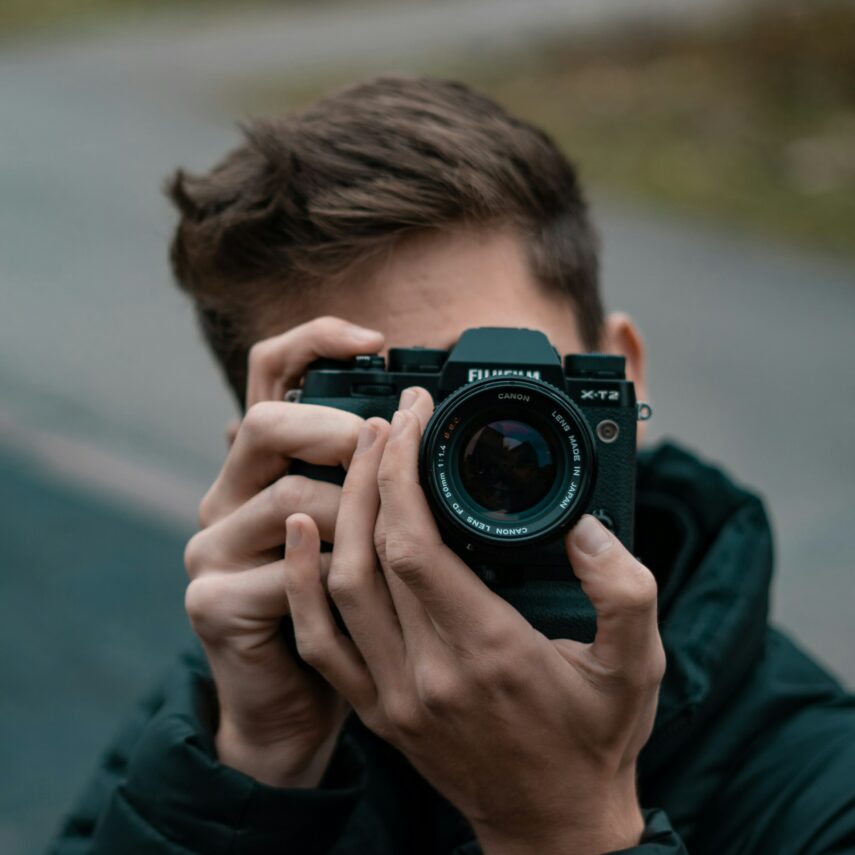
Street photography has one rule that overrides everything else — the shot either exists or it doesn’t, and hesitation is what kills it. Unlike studio or landscape work, you’re operating in real time with unpredictable light, moving subjects, and no second chances. The technical setup, compositional instincts, and ethical approach you develop early will determine whether you come home with something worth keeping.
Camera Settings That Work in Any Street Situation
The goal with street settings is to eliminate as many decisions as possible so you can focus on what’s happening in front of you.
Aperture and Depth of Field
Shoot between f/5.6 and f/8. This range keeps a wide depth of field so subjects at varying distances stay sharp without requiring precise focus for every frame. Wide-open apertures like f/1.8 look appealing on paper but demand focus accuracy you rarely have time for on a busy street.
Shutter Speed and ISO
Set your shutter speed to at least 1/250s to freeze movement — faster if your subject is running or you’re in a crowd. In low light, push ISO rather than dropping shutter speed. Modern smartphones and mirrorless cameras handle ISO 1600–3200 cleanly enough for street work. Grain in a street photo is forgivable. Motion blur almost never is.
Autofocus Mode
Use continuous autofocus if your camera supports it. On a smartphone, tap to lock focus on the area where you expect your subject to enter the frame, then shoot. Zone focusing — pre-focusing at a fixed distance like 2–3 meters and stopping down to f/8 — is a classic street technique that removes autofocus lag entirely and works well in daylight.
Shoot in RAW
Even on a phone with ProRAW capability, shooting RAW gives you recovery room for blown highlights and crushed shadows that JPEG simply doesn’t offer. Street light is unpredictable. RAW handles that unpredictability better.
Composition on the Move
Good street composition is built on anticipation, not reaction. You see a strong background — a graphic shadow, a peeling wall, a shaft of light — and you wait for a subject to enter it rather than chasing subjects and hoping the background works out.
Use the Environment as a Frame
Doorways, arches, windows, and tunnels naturally frame subjects and draw the eye. Position yourself so the frame is in your shot, then wait. This technique works even for beginners because it removes the pressure of chasing a moving subject and replaces it with the simpler task of waiting for one to arrive.
Foreground and Layers
Flat street photos fail because everything sits at the same visual depth. Add foreground interest — a blurred figure in the near frame, a railing, a reflection in a puddle — and the image immediately gains dimension. Some of the strongest street photos have three distinct layers: foreground, subject, and background, each telling part of the story.
Get Closer Than Feels Comfortable
Most beginners shoot from too far away. The subject gets lost, the background dominates, and the image loses impact. Henri Cartier-Bresson worked with a 50mm lens at close range for a reason — proximity creates intimacy and forces the viewer into the scene. Take one step closer than your instinct tells you to, and evaluate whether the frame improves.
The Ethics of Photographing Strangers
This is the part most guides skip or soften. It deserves directness.
Know the Law Where You Are
In most public spaces across the US, UK, and EU, photographing people without their consent is legal. You have the right to shoot anyone in a public place. Legal and ethical are not the same thing, and knowing the law is the floor, not the ceiling, of how you should operate.
How to Approach the Moment
Candid photography — shooting without the subject’s awareness — is the foundation of the genre. It captures genuine expression and unguarded behavior that posed shots cannot. The ethical obligation is to use that access responsibly. Avoid photographing people in moments of vulnerability, distress, or private grief. A person crying on a park bench has not consented to becoming content.
If someone notices you and looks uncomfortable, lower the camera. If they ask you to delete a photo, do it — regardless of your legal right to keep it. The relationship between photographer and subject doesn’t end at the shutter click.
When to Ask
For portraits — when you want the subject’s face to be the focal point and the image is clearly about them as an individual — ask first. A brief, direct approach works best: show them the shot, explain what you’re doing, and ask if they mind. Most people say yes. Those who say no have told you something important about the kind of photographer they need you to be.
Starting Out
Go to the same location multiple times before moving on. Familiarity with a place removes the cognitive load of navigation and lets you focus entirely on light, people, and timing. Shoot for an hour, edit ruthlessly, and keep only the frames that would stand alone without context. That standard — would a stranger find this image interesting — is the honest measure of whether street photography is working.